

It doesn’t announce itself.
It shows up quietly — right after the win. Right after the promotion, the praise, the moment where, by every external measure, you’ve arrived.
And instead of pride, you feel something closer to dread.
Like someone is about to find out.
I know this pattern. I’ve lived it. And I work with people who carry it every day — high-functioning, deeply capable, genuinely accomplished autistic adults who cannot fully land in their own success. Not because they’re fragile. Not because they’re wrong. But because their nervous system learned very early that being “too much” or “not enough” was the price of showing up differently.
That’s not imposter syndrome as most people describe it. That’s something layered.

What’s actually happening
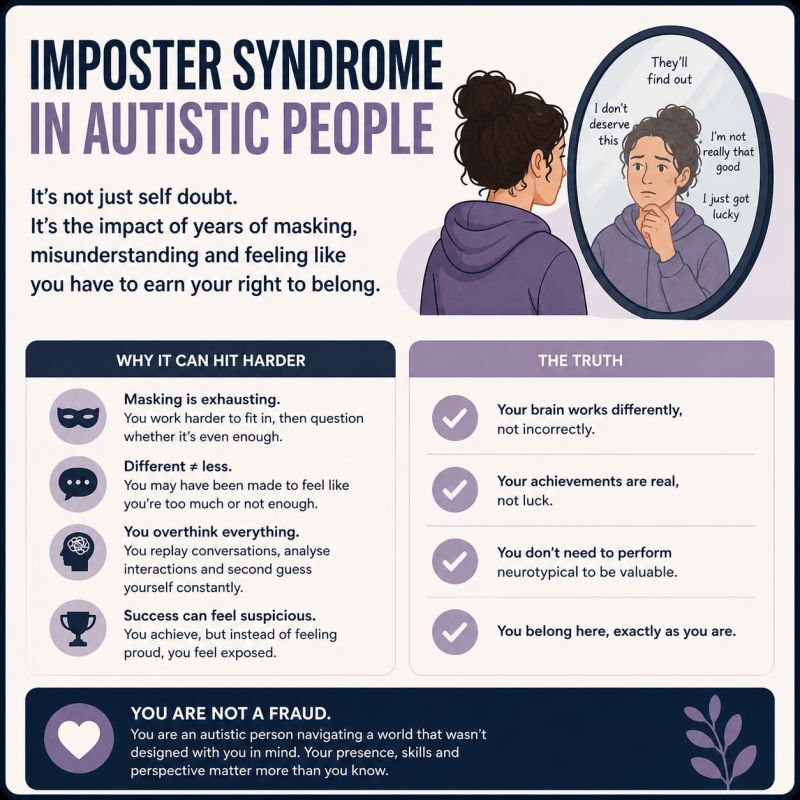
Imposter syndrome, in its standard definition, is the gap between external achievement and internal belief. Most people experience it as a whisper. For autistic people — especially those who spent years masking — it’s often much louder than that.
Here’s why.
Masking isn’t just a coping strategy. It’s a full-body performance. It’s monitoring your tone, your eye contact, your timing, your facial expressions, your word choice — all while trying to do the actual work in front of you. The cognitive load is real. The exhaustion is real. And over time, masking builds a belief that takes root quietly and stays for years: what they see isn’t actually me.
If you’ve spent your whole career performing competence on top of competence — managing your neurology and your deliverables — it makes complete sense that success would feel borrowed. Because it took twice the effort, and none of that effort was visible.
They saw the output. They didn’t see what it cost.
The perfectionism piece
I’ve written before about how perfectionism shows up in autistic people — how it can be a superpower and a trap at the same time, sometimes on the same afternoon. Imposter syndrome and perfectionism are close cousins. Both are rooted in the same fear: that if people really saw how I operate, they’d question whether I belong here.
The standard advice is to “just accept the compliment” or “look at the evidence.” But that advice assumes the doubt is irrational. For autistic people, it often isn’t. It’s the logical conclusion of years of feedback — some of it subtle, some of it not — that your way of being in the world is wrong, difficult, or requires explanation. That wires something. And it doesn’t unwire just because your LinkedIn says you’re successful.
What you’re not saying out loud at work
You know how much effort it takes to show up in certain rooms.
You know the pre-meeting prep that goes beyond knowing the content — the script you run, the scenarios you rehearse, the social calibration that happens before you ever open your mouth.
You know the pre-meeting prep that goes beyond knowing the content — the script you run, the scenarios you rehearse, the social calibration that happens before you ever open your mouth.
You know that when you communicate differently or process out loud or need a moment that most people don’t seem to need — you read the room. You adjust. You wonder afterward if you said too much, moved too fast, came across the wrong way.
... And then the meeting goes well. Your idea lands. You get the credit.
...And part of you wonders: did that count? Or did I just manage to hide well today?
That’s not self-pity. That’s a real question that comes from real experience.
What I want to say directly
Feeling like a fraud is not the same as being one.
The feeling makes sense given your history. It is a response — a very reasonable one — to years of operating in spaces that weren’t designed for how your brain works. Your nervous system learned to stay alert. Learned not to trust the good moments too quickly. That was protective once. It’s also something you can work with. Not by telling yourself the doubt is wrong, but by understanding where it came from and building a relationship with your own competence that doesn’t depend on external validation to stay intact.
- You did the work. All of it.
- The part they saw, and the part they didn’t.
- Both count.
If this landed for you, the perfectionism piece goes deeper on the internal cost of high standards in autistic adults. And if you’re navigating these patterns in your professional life — especially around masking, identity, or the weight of being “high-functioning” — this is exactly the work we do at Swift Mind Care.